Table Of Content
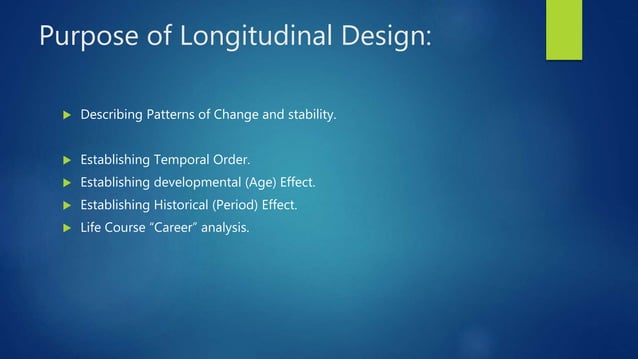
Depending on your research objectives, a cross-sectional design might do the trick. If you’re unsure, speak to your research supervisor or connect with one of our friendly Grad Coaches. As you’ve seen, longitudinal studies have some major strengths over cross-sectional studies. Well, there are (naturally) some disadvantages to longitudinal studies as well. From this example, you can probably see that the topic of both studies is still broadly the same (teenagers’ views on income inequality), but the data produced could potentially be very different. This is because the longitudinal group’s views will be shaped by the events of the next five years, whereas the cross-sectional group all have a “2020 perspective”.
What is an example of a longitudinal study?

Alongide our experience and consultation with experienced qualitative researchers, we have also searched the literature to find out if there is any clear information on each issues/topic. Recommendations, thus, were both experience-based and literature based, although due to lack of or limited literature around some of the issues discussed, experience-based recommendations were more common. This paper was developed to give examples of how specific ethical and practical issues in the project were tackled so they might stimulate debate and discussion amongst LQR researchers.
Longitudinal Designs
The opposite of a longitudinal study is a cross-sectional study, which is a design where you only collect data at one point in time. Introducing Appinio, the real-time market research platform that revolutionizes longitudinal studies and empowers businesses to make data-driven decisions like never before. With Appinio, conducting your own market research is a breeze, and the benefits of longitudinal studies are unmatched. Effectively reporting and communicating your longitudinal study findings contributes to the scientific community and helps bridge the gap between research and practical applications.
Prospective studies
In this article, we’ll show you several ways to adopt longitudinal studies for your systematic investigation and how to avoid common pitfalls. The only way to ensure relevant and reliable data is to use an effective and versatile data collection tool. Using data from other sources saves the time and money you would have spent gathering data. You are limited to the variables the original researcher was investigating, and they may have aggregated the data, obscuring some details. If your answer to any of these is no, you need to think carefully about the viability of a longitudinal study in your situation.
What’s the difference between a longitudinal and case-control study?
Recording is facilitated, and accuracy increased, by adopting recognised classification systems for individual inputs (2). It is thus generally less valid for examining cause-and-effect relationships. Nonetheless, cross-sectional studies require less time to be set up, and may be considered for preliminary evaluations of association prior to embarking on cumbersome longitudinal-type studies. Examples of longitudinal studies extend back to the 17th century, when King Louis XIV periodically gathered information from his Canadian subjects, including their ages, marital statuses, occupations, and assets such as livestock and land.
By utilizing the appropriate statistical techniques and interpreting results thoughtfully, you can make valuable contributions to your field of study. Once you have collected the data in your longitudinal study, the next critical step is to analyze it effectively to draw meaningful insights and conclusions. Now that you understand the basics of longitudinal studies, let's delve deeper into the crucial planning and design phase.
LQR is a prospective approach and therefore can give a different perspective on processes. Issues that seem very important at one time point may change with the perspective of time and processes may change the way experiences are viewed. One off qualitative interviews rely on recall, for example, asking about symptom experience at diagnosis when a patient is several months away from that point. There will always be some element of retrospective discussion in an LQR interview but with a focus on change over time, this can be aided by summarizing or reflecting on the previous interview.
How to perform a longitudinal study
Conducting longitudinal research is demanding in that it requires an appropriate infrastructure that is sufficiently robust to withstand the test of time, for the actual duration of the study. It is essential that the methods of data collection and recording are identical across the various study sites, as well as being standardised and consistent over time. Data must be classified according to the interval of measure, with all information pertaining to particular individuals also being linked by means of unique coding systems.
Research approaches like thematic analysis and content analysis benefit from a large set of data that helps you identify the most frequently occurring phenomena within a research context. Large data sets collected through longitudinal studies can be useful for separating abundance from anecdotes. In a longitudinal study design, that same survey will be distributed to the same group of people at different time intervals (e.g., twice a year or once a month) to allow researchers to see if there are any changes. Perhaps there is an ice cream that is as popular in the winter as it is in the summer, which may be worth identifying to expand profitability. One key difference is that longitudinal studies follow the same sample of people over an extended period of time, while cross-sectional studies look at the characteristics of different populations at a given moment in time.

We'll explore the various steps involved in reporting and disseminating your findings to both the scientific community and broader audiences. Determining the timeframe and frequency of data collection points is crucial. The choice should align with your research objectives and the nature of the phenomena you are studying. Choosing the proper sampling method is pivotal to the success of your longitudinal study. The method you select will influence the representativeness of your sample and, subsequently, the generalizability of your findings.
A 4-year longitudinal study investigating the relationship between flexible school starts and grades Scientific Reports - Nature.com
A 4-year longitudinal study investigating the relationship between flexible school starts and grades Scientific Reports.
Posted: Thu, 24 Feb 2022 08:00:00 GMT [source]
Still, cross-sectional studies are more beneficial for establishing associations between variables, while longitudinal studies are necessary for examining a sequence of events. Using already collected data will save you time, but it will be more restricted and limited than collecting it yourself. When collecting your own data, you can choose to conduct either a retrospective or prospective study. The longest-running longitudinal study in the world today was started in 1921 by psychologist Lewis Terman.
Focusing on the purpose of the research, finding different ways to ask questions can avoid repetition and participants anticipating questions and giving the “right” response [28]. It is also wise to involve patients or service users in the design of the research and ongoing management to get the participants’ perspective of burden and balance research interest with participants’ well being. If you’re conducting a retrospective study, you’d have to collect data on events that have already happened. A longitudinal study or a longitudinal survey (both of which make up longitudinal research) is a study where the same data are collected more than once, at different points in time.
An excellent example of a longitudinal study is market research to identify market trends. The organization's researchers collect data on customers' likes and dislikes to assess market trends and conditions. An organization can also conduct longitudinal studies after launching a new product to understand customers' perceptions and how it is doing in the market.
Detecting cohort effects is important but can be challenging as they are confounded with age and time of measurement effects. Attrition over time is the main source – participants dropping out for various reasons. The consequences of missing data are reduced statistical power and potential bias if dropout is nonrandom.




No comments:
Post a Comment